Usually, yes, if both units are near the end of their life. One visit, one set of permits and one crew costs less than two separate jobs, and the indoor parts have to match anyway. But replacing both together is not always the right call in Wasaga Beach. The furnace does far more work here than the air conditioner does, and that changes the maths.
Why does replacing both at once cost less?
A central air system has three main parts:
- The outdoor condenser.
- The indoor coil, which sits on top of the furnace in the supply plenum.
- The refrigerant lines that run between them.
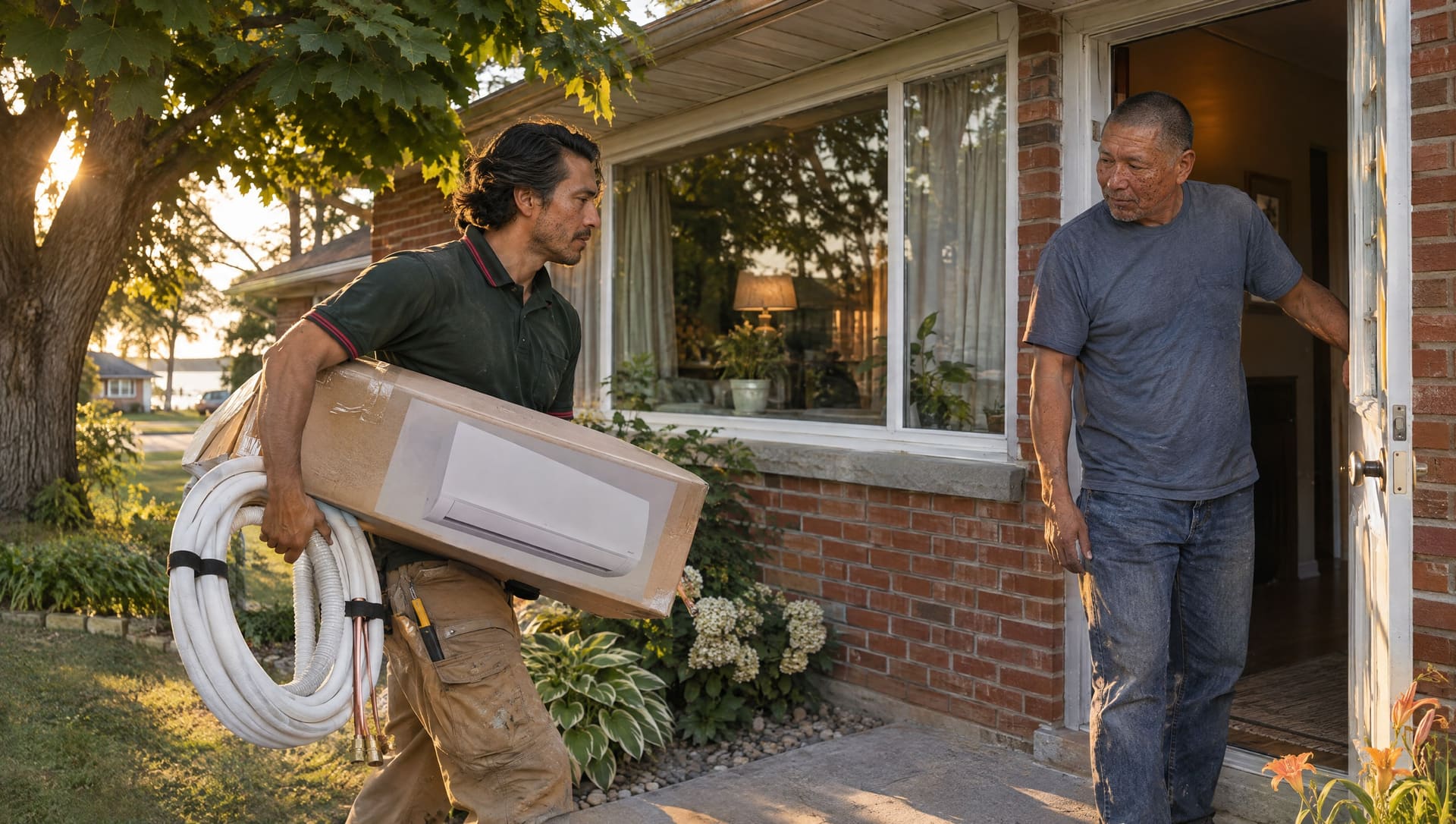
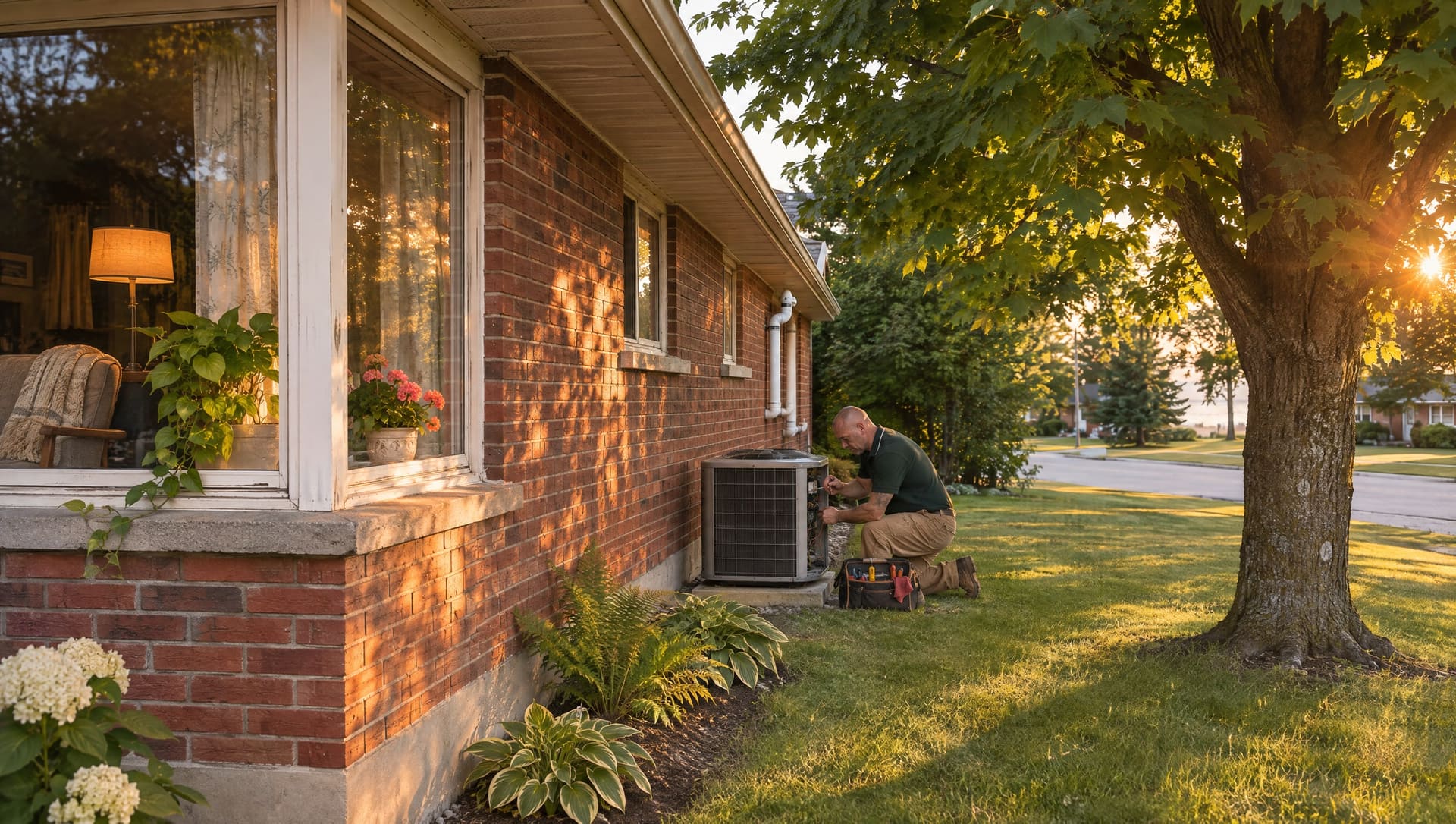
When the furnace is replaced, the coil has to come off and go back on, and the plenum is often rebuilt to fit the new cabinet. If the air conditioner is replaced at the same time, that work is done once instead of twice. So are removal, disposal, electrical work and the start-up checks.
The second saving is in how the system runs. The furnace blower moves the air across the cooling coil, and a new coil and condenser are rated to work with a particular blower and airflow. Put a new furnace with an old coil, or a new outdoor unit with an old furnace, and the system may not reach its rated efficiency. Manufacturers often base their warranty terms on matched equipment too, so read the warranty terms before you mix old and new.
When should you keep the old air conditioner?
Environment Canada's 1981-2010 normals for Thornbury Slama, the station on the Georgian Bay shore just west of Wasaga Beach, show 4187.5 heating degree-days a year and only 207.8 cooling degree-days. The average July daily high is 24.8 °C. That means a lot of furnace hours and few air conditioner hours.
An air conditioner that runs a few weeks a year wears more slowly than the furnace beside it. If the furnace is failing and the AC is younger, cools properly and isn't leaking, keeping it is a reasonable choice. Ask the technician to check three things first:
- Coil condition. A corroded or leaking coil is a reason to replace both now.
- Refrigerant type. Older systems use a refrigerant that is no longer made. If yours needs a recharge, that refrigerant is getting harder and more expensive to buy.
- Fit with the new furnace. The old coil has to fit the new cabinet, and the new blower has to be set to the airflow the old coil needs.
If the AC passes, replace the furnace now and price the AC as a separate job later. If it fails any of the three, replacing both at once is usually cheaper over the next few years than doing two installs.
Does the age of the house change the answer?
Yes. Wasaga Beach has three main kinds of housing, and each has its own heating setup.
**Early cottages near the bay.** The first cottages, built from the early 1900s on the side streets between Mosley Street and the bay and in Oakview Beach, were summer buildings with no central heating. Heat was added later, sometimes as a furnace squeezed into a crawlspace with improvised ductwork. Small or makeshift ducts may not carry enough air for central air conditioning, so ask whether the ducts can handle the airflow before you buy a matched pair.
**1960s to 1990s houses in the annexed beach communities.** In Springhurst Beach, New Wasaga Beach, Brock's Beach and Bower's Beach, houses were often built with electric baseboards or a chimney-vented mid-efficiency furnace.
- If there is no ductwork, there is no central air to replace. A ductless system or a heat pump is the choice to look at. See air conditioning for a house with no ductwork.
- If there is a chimney-vented furnace, replacing it with a high-efficiency model changes the venting. Any appliance left in the chimney, such as a gas water heater, may then need a liner. Ask about that before you compare quotes.
**Newer subdivisions such as Sunnidale Trails.** These houses mostly have high-efficiency condensing furnaces that vent through plastic pipes in the side wall, and ductwork sized for central air. They are the simplest place to do a matched replacement. Plan where the vents and the new condenser will go: the Thornbury Slama normals show 266.6 cm of snow a year, with 79.1 cm in January alone. A vent or an outdoor unit placed where drifts collect will cause trouble every winter.
Should the air conditioner be a heat pump instead?
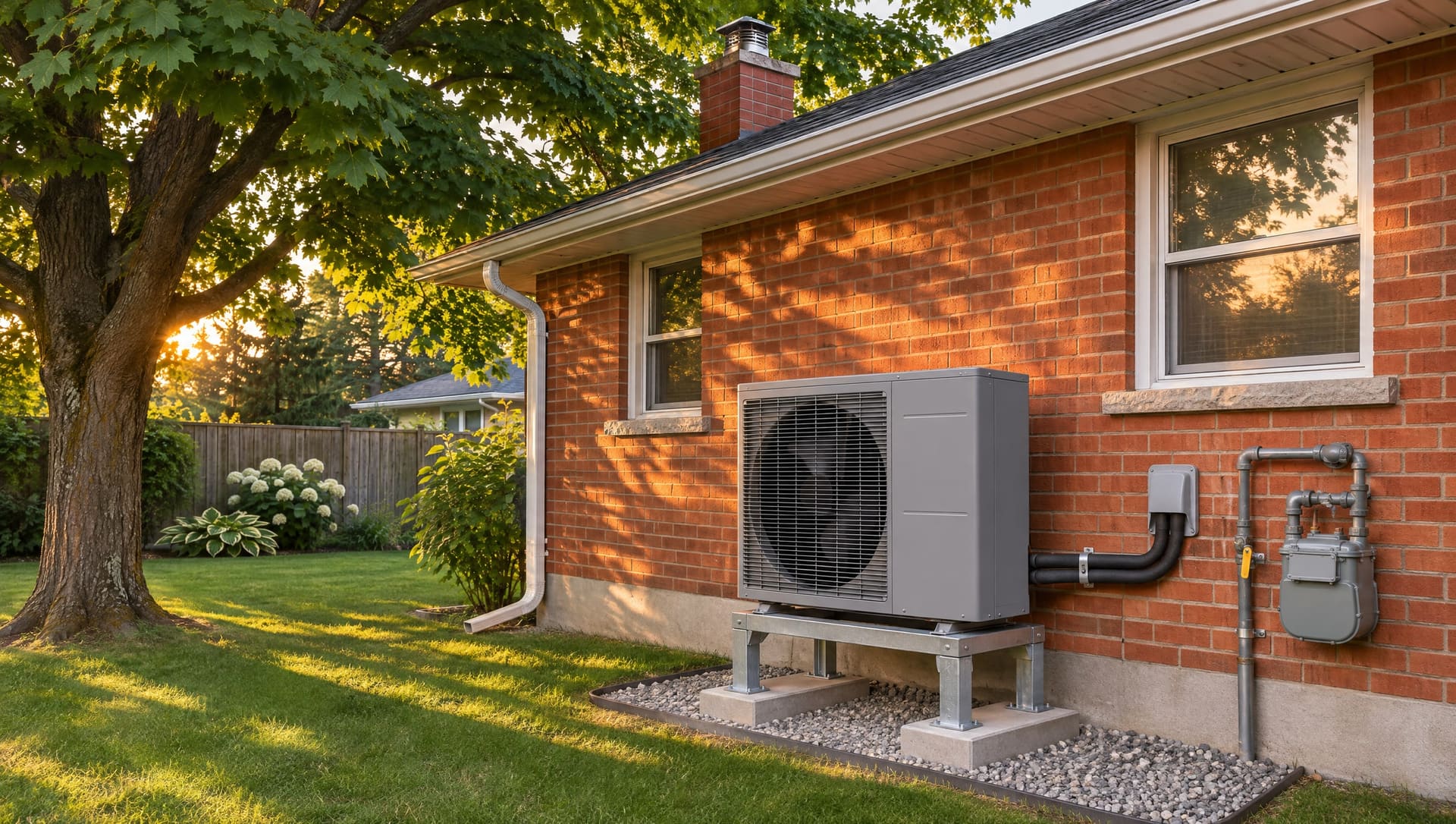
If you are replacing both, look at this before you sign. A heat pump goes where the air conditioner would go. It cools in summer and also heats in spring and fall, and the furnace takes over in deep cold. This is often called a hybrid system.
In a town with a short cooling season, a plain air conditioner sits unused most of the year, and a heat pump does not. Two points apply locally:
- The outdoor unit has to sit above the snow line and be kept clear.
- Rebates and programs change. Check what is on offer when you book, not what a neighbour got a few years ago.
See heat pumps for more on how they suit different houses.
Does your street have natural gas?
Enbridge Gas holds the natural gas franchise for the Town of Wasaga Beach, but not every street has a gas main. The utility's new-customer page checks by postal code whether a property is in its service area, and it has a separate process for homes where gas is not on the street.
If you are on propane, oil or electric heat and want to switch, check this first. The answer decides whether a gas furnace is even possible, and it changes the comparison with a heat pump. See the cheapest way to heat a Wasaga Beach home.
How much is a new AC for a 2,000 square foot home?
Square footage alone can't tell you. Two houses of 2,000 square feet can need different sizes of air conditioner. What decides it:
- Heat gain: windows, the direction they face, insulation, air leakage and the number of floors. A cottage with thin insulation gains heat faster than a newer house of the same size.
- Ductwork: if good ducts are already there, central air is mostly equipment and connection. If there are none, you are pricing ductless heads or new ducts.
- The furnace: a new coil has to fit the furnace cabinet and suit its blower. If the furnace is near the end of its life too, this is where the shared-labour saving comes in.
- Line set and electrical: whether the refrigerant lines can be reused, whether the electrical panel has room for the circuit, and how far the condenser sits from the furnace.
- Placement: a pad or wall bracket high enough to stay out of drifts and away from the roof drip line.
A proper quote starts with a room-by-room heat-gain calculation, not the label on the old unit. With 207.8 cooling degree-days a year, an oversized unit is wasted money. It cools the air quickly, shuts off before it removes the humidity, and costs more to buy. Ask any contractor how they sized the unit.
Who can do the work?
Gas appliances in Ontario are installed to the CSA B149.1 code under Ontario Regulation 212/01. Work is performed by TSSA-certified gas technicians.
Refrigeration and air conditioning is a compulsory trade in Ontario. Work is performed by 313A refrigeration and air conditioning mechanics.
A replacement that covers both needs both kinds of qualification, so ask about each when you compare quotes.
When is the best time to replace?
If the furnace is still running, spring or early fall gives you time to compare written quotes. Waiting until it fails in January does not. Many Wasaga Beach homes are seasonal: in the 2021 census, 10,811 of the town's 13,768 private dwellings had usual residents living in them.
If your house sits empty over winter, plan the replacement for when you are there to approve it, and make sure the new system is checked before you leave. Every home with a fuel-burning appliance also needs a working carbon monoxide alarm next to each sleeping area. Check yours whenever the furnace is replaced.
What is the short answer?
- Both units old or failing: replace them together. It costs less and you get a matched system.
- Furnace failing, AC in good shape: replace the furnace and keep the AC, as long as the coil fits and works with the new furnace.
- No ducts: skip central air and look at ductless or a heat pump.
- Replacing both anyway: price a heat pump against a plain air conditioner.
To price a furnace replacement, with or without the air conditioner, see furnace installation and replacement.